
600 to 700 hours
This stage took a total of 144 days. And that was disappointing. It’s not the slowest, as the first stage took me almost a year.
To me the last 10 to 15 minutes of standing meditation are often quite a challenge. For most practitioners it’s the first 20 minutes that are difficult because you always have to find the right posture, but I seem to be an exception to that rule.
The hard first minutes was certainly an issue for me during the first 200 hours, but now I’m standing perfectly in no time. It’s like muscle memory in action! I still feel the process of relaxing further and deeper after finding the posture, but that process feels like it’s completely automatic. The body’s own intelligence makes it almost autonomous; there’s no noticeable influence from the brain. Jing has evolved beautifully.
The challenge now lies in those last 10 to 15 minutes in which I feel like I’ve reached a limit. My body isn’t tired, my emotions remain calm, but it seems like my mind has had enough at those moments and starts wandering.
I could make a fuss about that, but it’s also a valid point: the mind struggling to maintain itself at this moment. This way, a problem doesn’t become an obstacle, but an interesting hurdle, when you know you can trust that you will overcome it too.
September 15, 2025
Recently, I haven’t been able to maintain the practice for 60 minutes daily. The quality of the practice is good, though. I’m always very close to total unification with QI. I find the background of silence easier and easier to experience. There’s something about practicing less forcefully. You often feel that there’s really no point in adding another 20 minutes to the practice. That it will trigger aversion, which could backfire the next day. In that case, I simply stop. Flexibility; I do believe in that.
I’m focusing more on raising my frequency again. That makes the practice especially enjoyable to do, and that’s the greatest benefit of this intention.
Keeping the muscles completely still for an entire hour is often difficult too. Sometimes my arms suddenly, almost spontaneously, make a sudden move. After such an involuntary movement, the Qi feels better, as if some trapped Qi was released in that movement. According to Arianne, my teacher, that spontaneous movements are not so bad. Those sudden movements only stop if I remain very aware of my body. Then I feel them coming and can nip them in the bud. I wonder what’s the better choice: when my mind is completely quiet movement may occur, when I’m aware of the body they don’t but it’s much harder to keep the mind silent.
October 30, 2025
For the first time, I have an slight injury. Luckily, not in my knees—that’s what I’ve been warned about—. A muscle in my left thigh is acting up. It could be a pinched nerve. This makes it difficult to stand for a full hour. I tried introducing two sessions a day and breaking up the hour. First, 45-minute sessions, then I break them up but add even more time each day. But that turned out to be too much for me at the moment. My leg just can’t handle it.
I cut it back to half an hour per session, which was just about right. I was really bummed because I feel like I can’t practice as comfortably now. The injury was caused by doing additional strength exercises – called the 8 cultivating exercises -. alongside the standing meditations That strength training brought me many benefits, but it also resulted in an injury.
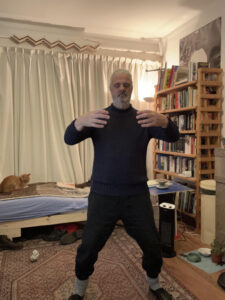
Actually, everything is coming full circle now. I’ve gone through the phases of Jing, Qi, and Shen. Now I’m back to Jing; the physical body. The training is more intense than ever, and my legs are shaking again. My emotional body also seemed a bit more restless.
During my trip to Nepal, I trained consistently every day. For four days, I managed an hour, for three days, 45 minutes, and for two days—the days with the plane flights in and out—only 30 minutes.
December 12, 2025
During the supervision teachings with Arianne, I gained a clear insight into why my mind screams “Enough.” I’ve closed myself off to extrasensory perception. This blockage is fuelled by fear of disparaging reactions from the outside world to my experiences. I’ve experienced extra sensory perceptions earlier in life. Now I discovered that I’ve developed a coping mechanism for this. The safe part of my body is the lower dantian; the physical body. I unconsciously send all my Qi there as soon as I enter the Xu Kong state—the emptiness that isn’t empty.
The beauty is that when you persistently practice, in time, such a coping mechanism will be revealed. In this case, the coping mechanism manifested because my body could no longer handle the imbalance in my Qi. It almost literally became too heavy for my body to carry all that Qi. Qi needed to be better distributed across the dantians; the organism always wants to maintain balance.
What helped me break through this coping mechanism was adopting the traditional Zhan Zhuang posture where Lao Gong—the palms of the hands—are held at chest height at the boundary between the middle and upper dantian, instead of in front of the abdome,. This allows the Qi to flow more easily through the upper and middle dantians, makes uniting the dantians easier and more tangible, and easier to maintain the Xu Kong state.
Now it’s time to set a new, clear intention: I want to move towards the full potential of my mind. My body feels strong, my emotions are completely calm and my mind is silent; let the good things happen! And let the world react as it pleases. I don’t bother about it.
It also helps to direct my Qi towards others. For example, towards Silvie, a fellow Chi Neng practitioner, who has entered the terminal phase of her illness. The idea that you’re practicing for others, not just yourself, is simply wonderful and liberating. We won’t settle for less! Send that Qi! Heal the world.
I’ve completely recovered; back to training for a fixed hour a day. The injury is gone, my neighbor will hopefully finally finish his months-long renovation this month, and winter is over its worst.
Haula